The first step in the process of cheese making is the production of the milk. To meet the demands of our clients, it has to be of a good even quality throughout the year. This means controlling the timing of births, and above all that the food for the goats is appropriate to the season.
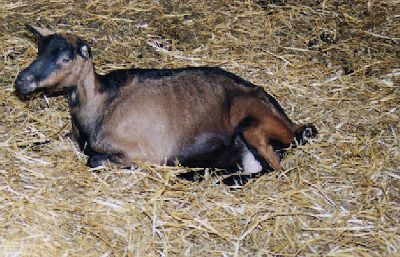
For an effective breeding programme the environment must be healthy. The bedding is a kind of straw matress which must always be kept clean. A goat likes lying on the bedding whilst peacefully chewing the cud. A goat’s stomach is divided into four compartments. After being eaten the food descends into the stomach where it is broken down by micro organisms thus becoming very soft. Then cud chewing begins. The softened food comes back up into the mouth of the goat where it is thoroughly chewed over a long period until it becomes soupy. The food then goes into the following stomach compartments where it’s transformed into microscopic nutrative elements. When digestion is complete these elements pass into the bloodstream where they provide nourishment for all the body organs but especially the teats.
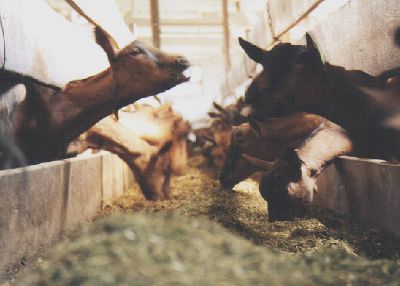
Inside the goat house food is distributed all the year using a central belt. Goats like the highly perfumed wild plants like sage, thyme or rosemary which add flavour to their milk and cheese. Of the approximately 600 plants goats eat 460, which makes them the easiest of all ruminants to feed. In the goat house they eat corn, silage, maize and alfafa which has a sugar flavour.
A goat produces milk for 10 months following the birth of
kids. She then has 2 months rest before the next birth. In order to
produce cheese the whole year round milking has to be possible at all times.
Therefore the birth of the young is organised by groups of fifty goats so that
there are always enough of them lactating at any one time. The result of this
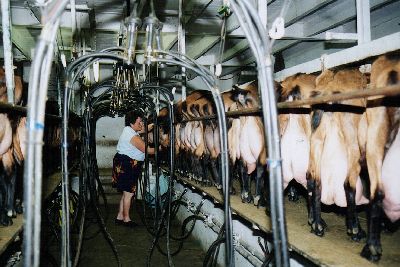
organisation becomes evident at milking time. The goats are milked in the
morning and the evening every day of the year. They do not come into the milking
parlour to eat but rather to ease the pressure on their teats which are full of
milk. As soon as the goats have been milked they return to the goat house to
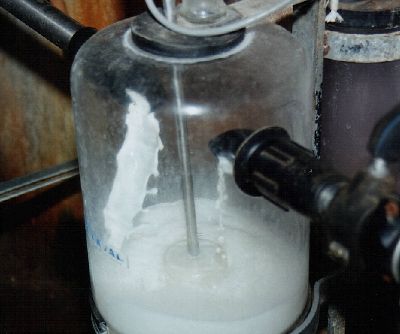
make way for the next group of fifty. The milk is placed in milking goblets.
The milk passes through stainless steel tubes directly into a
vat where it is quickly cooled to 3 or 4° centigrade. It is thus protected
against microbes whilst waiting to be turned into farm cheese. Goat’s milk is
very white because the carotene in plants doesn’t pass into it very much.
A goat gives 2 to 2.5 litres of milk a day . That’s an average
of 700 litres a year

